Next month, Catharine Ward Thompson, Professor of Landscape Architecture at the University of Edinburgh and Director of the OPENspace research centre linked with Heriot-Watt University, is speaking at the British Academy Big Debate on the body, brain and wellbeing. In this blog post, she takes us through some of the issues she will be raising as she asks, "are our communities – as places – ready for the opportunities and challenges posed by an ageing population so that old age might really offer some of 'the best years of our lives'?"

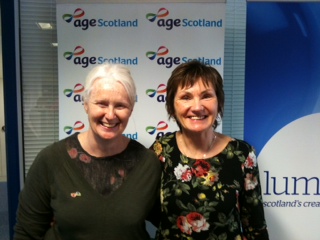
Catharine Ward Thompson at the first Advisory Group meeting of the Mobility, Mood and Place research project in January 2014. Age Scotland is partnering the research and the meeting was attended by Greg McCracken, Policy Officer at Age Scotland.
Image © John McGonagle
In my research, I'm interested in the potential offered by open space, at all scales, to enable people to be more active outdoors and engage positively with the natural environment. From recent research, such as the ten-year project Inclusive Design for Getting Outdoors (I'DGO), I know that this is important across the life course; that getting out and about into oldest age can enhance both physical and mental health and wellbeing and make a real difference to quality of life. I'DGO demonstrated that, if older people live in an environment that makes it easy and enjoyable for them to go outdoors, they are more likely to spend a longer time outdoors, to be more physically active and to feel more satisfied with life. Participants in our study were twice as likely to achieve the recommended levels of healthy walking if they lived in an environment that they felt to be 'supportive'.
As our understanding of the consequences and implications of a rapidly ageing population has grown, much has been done, through I’DGO and other studies, to identify how to address the physical barriers to getting outdoors that some older people encounter. There is better awareness of the need for good design and, importantly, for higher standards of maintenance. For many reasons, not least financial constraint, our neighbourhoods might not meet these standards, but we have good evidence that they should. We know, through the project Go Far, for example, that better maintained footpaths could make a real difference to the incidence of outdoors falls and to the fear of falling among older people.
In my current research project, Mobility, Mood and Place (MMP), I am working with a team of experts from Edinburgh and other universities to look beyond physical barriers to older people getting outdoors, to find out what other factors help make a neighbourhood environment 'supportive'. We are building on earlier findings on aspects of the outdoor experience that make a difference to its quality, such as pleasantness, personal safety and stimulation. We are investigating, through working with architects in training, how older people can play a more active role in the design process and, using mobile neural imaging, studying real-time emotional responses to place. Working with data from the Lothian Birth Cohorts of people in their 70s and 90s, we are also considering the influence of local environments in which people have lived from childhood.
If you would like to hear more about my current and recent research and how it feeds into wider debates about our communities and their readiness or suitability for ageing, please join me at the British Academy Big Debate, The Best Years of our Lives?, at the Assembly Hall (The Mound) in Edinburgh on Tuesday 29th April 2014 at 6pm. The event is free but ticketed (register here). The debate will be chaired by actor, Simon Callow. My colleague on Mobility, Mood and Place, Professor Ian Deary of the Centre for Cognitive Ageing and Cognitive Epidemiology (CCACE), will also be speaking, as will Sir Alan Peacock and BBC Scotland news presenter and journalist, Sally Magnusson.